The Day Wall Street Exploded A Story of America in its First Age of Terror by Beverly Gage (2009)
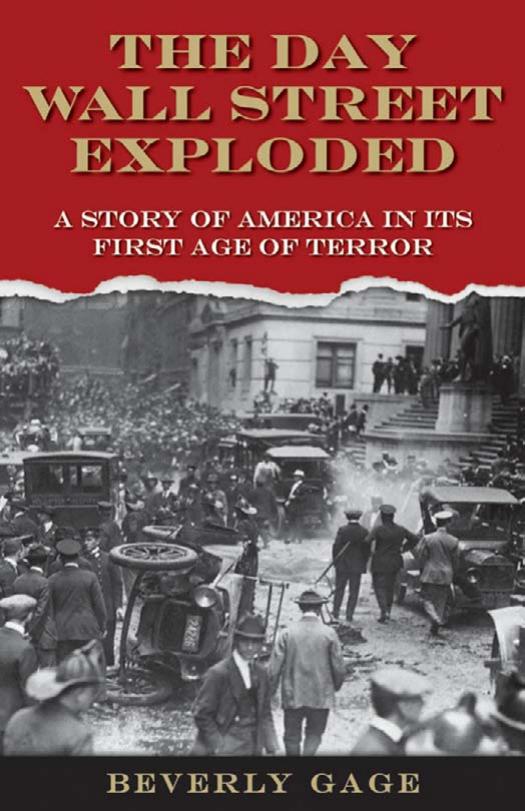
Author:Beverly Gage (2009) [Gage, Beverly]
Language: deu
Format: epub, pdf
Published: 2009-10-21T15:21:12+00:00
The “Great Detective” Returns
Burns did not have this information at hand when he assumed the
leadership of the Bureau in August 1921; after leaving New York, Linde
all but ceased communication. Despite this puzzling silence, Burns had
reason to believe that his informer was on the up-and-up. In April, just
after Flynn’s arrest of Ligi, the Bureau and the New York bomb squad
had orchestrated a raid on prominent members of the Communist Party’s
New York branch, absconding with membership lists and secret codes.
Contained in those fi les, Burns claimed, was evidence that one “Linde”
was in the confi dence of the Third International. It was a mistake that
would later cost the Bureau dearly.23
burns was laid up with a cold just after his appointment to the Bureau,
the sort of minor illness that had become more than niggling as he passed
age sixty. He decided to stay at his country home in Scarborough, New
York, for at least a few days. To compensate for his temporary absence
from Washington, he invited reporters to his house to discuss plans for
reshaping the Bureau in the wake of Flynn’s failures. Sniffl es notwith-
standing, he sounded like his old progressive self as he charted schemes
for training, testing, and disciplining his agents into “the most effective secret service in the world.” As a government post, the Bureau job promised to be the culmination both of his legendary career and of the growing fusion between federal and private police. Just as the federal government
had recently begun to encroach on the traditional duties of local authori-
ties, it had more and more come to assume the roles—strikebreaking,
radical surveillance—long assigned to the private detective industry. As
an entrepreneur returning to government service, Burns embodied both
the past and future of law enforcement.24
To the fi nanciers and industrialists who had long employed Burns men
to investigate crimes and break strikes, this sounded like an ideal arrangement. “There is joy all along the [Pennsylvania] avenue,” Chicago Banker magazine remarked, “on the report that President Harding is to make
William J. Burns ‘commander-in-chief’ of all the detective and secret ser-
vice departments of the government.” There was joy along Wall Street,
too. “[N]o man in his line in the United States,” one bank vice president
wrote to Washington, “has a stronger following among the bankers of the
country than Wm. J. Burns.” 25
To those who viewed the consolidation of private and federal power with
a bit more skepticism, the Burns appointment set off immediate alarms.
271
The Russian Connection
With the fi rst hints that Burns might be on his way to Washington,
trade unionists scrambled to compose protest letters, urging Harding
to appoint someone “about whom no odium has ever been cast.” Newspapers
sympathetic to their cause joined the attack as well, dredging up accusa-
tions of jury rigging, corruption, and underhanded union-busting tech-
niques. As Chicago Banker summed it up, the debate showed roughly that
“Labor is ‘ferninst’ [against] Burns, but everybody not in the ‘Union’ is
for him.” 26
In an effort to preempt criticisms that Burns would merely be a
strikebreaker in government clothes, Daugherty assured the press that
his old friend’s private-detecting days were at an end. “Mr. Burns has
severed
Download
The Day Wall Street Exploded A Story of America in its First Age of Terror by Beverly Gage (2009).pdf
This site does not store any files on its server. We only index and link to content provided by other sites. Please contact the content providers to delete copyright contents if any and email us, we'll remove relevant links or contents immediately.
Spell It Out by David Crystal(36120)
Life for Me Ain't Been No Crystal Stair by Susan Sheehan(35813)
Cecilia; Or, Memoirs of an Heiress — Volume 1 by Fanny Burney(32563)
The Great Music City by Andrea Baker(32024)
Cecilia; Or, Memoirs of an Heiress — Volume 2 by Fanny Burney(31962)
Cecilia; Or, Memoirs of an Heiress — Volume 3 by Fanny Burney(31945)
Professional Troublemaker by Luvvie Ajayi Jones(29671)
The Secret History by Donna Tartt(19105)
We're Going to Need More Wine by Gabrielle Union(19055)
Twilight of the Idols With the Antichrist and Ecce Homo by Friedrich Nietzsche(18642)
All the Missing Girls by Megan Miranda(16052)
Cat's cradle by Kurt Vonnegut(15365)
Pimp by Iceberg Slim(14522)
For the Love of Europe by Rick Steves(14177)
Bombshells: Glamour Girls of a Lifetime by Sullivan Steve(14081)
Norse Mythology by Gaiman Neil(13379)
Talking to Strangers by Malcolm Gladwell(13376)
Fifty Shades Freed by E L James(13247)
The Social Justice Warrior Handbook by Lisa De Pasquale(12197)
